
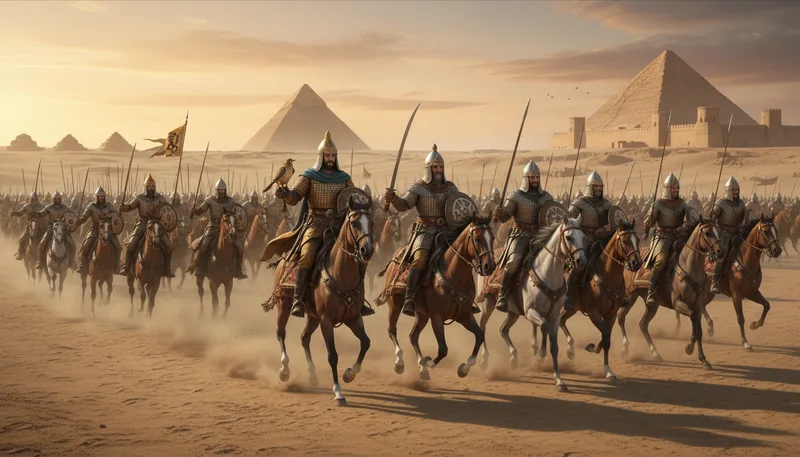
The word Mamluk literally means "one who is owned." In any other civilization, a class of slaves would be at the bottom of the social pyramid. In Egypt, they became the pyramid.
The Mamluk Sultanate (1250–1517) was one of the most curious political experiments in history. It was a "meritocratic slave-soldier military caste." Boys, mostly of Turkic or Circassian descent, were bought in the slave markets of the Eurasian steppe, brought to Cairo, converted to Islam, and subjected to a grueling military education. They owed no loyalty to family or land—only to their brothers-in-arms and the Sultan who had purchased them.
This made them the most disciplined, terrifying, and elite fighting force of the Middle Ages. And they took power just in time to save the world.
The Shield Against the Mongols
By 1260, the Mongol Empire had leveled Baghdad and was sweeping toward Africa. The "Scourge of God" seemed unstoppable. They sent an embassy to Cairo with a simple message: 'Surrender or be erased.'
The Mamluk leader, Qutuz, responded by executing the messengers and marching out to meet the Mongol horde at the Battle of Ain Jalut ("The Spring of Goliath"). Led by the brilliant general Baibars, the Mamluks used a classic feigned retreat to draw the Mongols into an ambush. It was the first time a Mongol advance had been permanently halted in hand-to-hand combat.
Egypt didn't just survive; it became the undisputed leader of the Islamic world. With Baghdad in ruins, the Caliphate moved its ceremonial seat to Cairo. The city became the final sanctuary for scholars, artists, and refugees fleeing the Mongol terror.
Baibars: The Panther of Egypt
After the victory at Ain Jalut, Baibars assassinated Qutuz and took the throne for himself. Known as *Abul-Futuh* (Father of Conquest), Baibars was a whirlwind of energy. He cleared the last of the Crusader strongholds from the Levant, built a postal system that could deliver a letter from Cairo to Damascus in four days, and solidified the Mamluk system.
The Mamluks didn't pass the throne from father to son (though some tried). Instead, the strongest general usually seized power. This led to a history of constant coups and palace stabbings, but it ensured that the man sitting on the throne in the Citadel was almost always a hardened, capable survivor.
The Architecture of Grandeur
Despite their violent politics, the Mamluks were obsessed with beauty. They spent their vast wealth—acquired by taxing the spice trade between India and Europe—on stunning religious complexes.
The Mosque-Madrasa of Sultan Hassan is perhaps the finest example. Built in the mid-14th century, its massive soaring arches and intricate stone carvings were designed to show that Cairo was the new Rome. Mamluk architecture is characterized by "ablaq" (alternating rows of light and dark stone) and magnificent "muqarnas" (stalactite-like vaulting).
The Black Death and the Spice Monopoly
The 14th century brought a silent invader that even the Mamluk cavalry couldn't defeat: the Black Death. The plague devastated Egypt’s population, particularly the skilled farmers of the Nile Valley.
To keep the treasury full, the Mamluks leaned harder on their monopoly of the spice trade. If a Venetian merchant wanted pepper, silk, or cinnamon, they had to buy it from a Mamluk middleman in Alexandria. For a century, this made Egypt the wealthiest spot on the map, but it also encouraged European explorers like Vasco da Gama to find a way around Africa to bypass the Mamluk tax.
The End of the Knights: 1517
The Mamluks were the ultimate masters of the sword and the horse, but they were stubbornly conservative. They viewed gunpowder and cannons as "unmanly" and beneath a true warrior.
To the north, the Ottoman Turks had no such qualms. In 1517, at the Battle of Raydaniyya just outside Cairo, the Ottoman Sultan Selim I used modern artillery to shred the Mamluk cavalry. The last Mamluk Sultan, Tuman Bay, was hanged from the Bab Zuweila gate in Cairo.
The Mamluk Sultanate was dead. Egypt was once again a province of a foreign empire, ruled from Istanbul. However, the Mamluk *caste* was so deeply embedded in Egyptian society that they didn't disappear. They remained as local lords and tax collectors, waiting in the shadows for three centuries until a short French general named Napoleon would arrive to change everything again.
Comments
No comments yet. Be the first to share your thoughts.
Join the conversation
Log in to leave a comment on InEgypt.