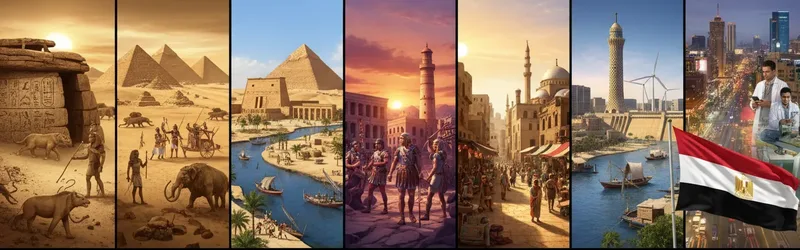

If Chapter 1 was about the struggle to survive and unify, Chapter 2 is about the audacity of the human ego. This is the era of the Old Kingdom (c. 2686–2181 BCE), a period where Egypt wasn't just a country; it was a well-oiled machine directed toward a single, mountain-sized goal: the defiance of death.
By the Third Dynasty, the "Two Lands" were stable, the grain stores were overflowing, and the bureaucracy was terrifyingly efficient. The kings of Egypt had transitioned from tribal unifiers to absolute god-kings. They no longer needed to prove their power through petty skirmishes; they intended to prove it through geology.
The Architect of Eternity: Imhotep and the Step Pyramid
For centuries, Egyptian kings were buried in mastabas —flat-roofed, rectangular mud-brick tombs that looked like giant benches. But around 2630 BCE, a king named Djoser decided he wanted something more. To get it, he turned to his vizier, Imhotep—a man so brilliant he was later deified as a god of medicine and architecture.
Imhotep had a radical idea: why not stack mastabas on top of one another?
He built a traditional mastaba, then added another smaller one on top, and another, until he had created a six-tiered limestone stairway to heaven. This was the Step Pyramid of Saqqara. It was the first large-scale stone structure in human history. Before this, the world built in wood, reed, and mud. Imhotep’s innovation signaled a shift in the Egyptian mindset: they were no longer building for the next generation; they were building for forever.
The Trial and Error of Sneferu
The transition from "steps" to the smooth-sided pyramids we recognize today wasn't a seamless jump; it was a process of expensive, terrifying trial and error led by a king named Sneferu, the founder of the Fourth Dynasty.
Sneferu was the greatest builder in Egyptian history, though his first attempts were... awkward.
The Meidum Pyramid: Originally started as a step pyramid, it was encased in limestone to make it smooth. It eventually collapsed, leaving behind a strange, tower-like core.
The Bent Pyramid: Halfway through construction at Dahshur, the structure began to crack under its own weight. The architects frantically changed the angle from 54^\circ to a shallower 43^\circ, giving it a "squashed" appearance.
The Red Pyramid: Finally, Sneferu’s team got it right. Using the shallower angle from the start, they created the world's first successful smooth-sided pyramid.
Sneferu’s obsession moved more stone than any other pharaoh in history, providing the "R&D" necessary for his son, Khufu, to take the concept to its ultimate conclusion.
Giza: The Apex of the Old Kingdom
When Khufu ascended the throne, he moved the royal necropolis to the Giza plateau. Here, he commissioned the Great Pyramid, a structure so massive that it remained the tallest man-made building on Earth for over 3,800 years.
The statistics of the Great Pyramid are mind-boggling even by modern standards:
Mass: Approximately 2.3 million stone blocks, some weighing up to 80 tons.
Precision: The base is level to within 0.6 inches, and the sides are aligned almost perfectly to the four cardinal points of the compass.
Labor: Forget the Hollywood myths of whip-cracking overseers and Jewish slaves (who wouldn't arrive in Egypt for centuries). The pyramids were built by a massive, organized workforce of roughly 20,000 to 30,000 paid Egyptian laborers.
This was the ultimate "Public Works" project. During the months of the Inundation, when the fields were underwater and farmers couldn't work, the state called them to Giza. They were fed prime beef, provided with medical care, and given the chance to participate in a religious act of national importance. To build the King’s tomb was to ensure the stability of Ma’at for everyone.
The Great Sphinx: The Guardian of the Horizon
Khufu’s son, Khafre, built the second pyramid at Giza, which appears taller because it sits on higher ground. But his most iconic contribution was likely the **Great Sphinx**. Carved directly out of the limestone bedrock, this lion-bodied, human-headed colossus represents the king as a solar deity, guarding the necropolis. It is the literal "Face of the Old Kingdom"—stoic, weathered, and immovable.
The God-King’s Bureaucracy
While the pyramids are the stars of the show, the true engine of the Old Kingdom was its civil service. This was the age of the Scribe. In a world where 99% of the population was illiterate, the ability to read and write hieroglyphs was a superpower.
The government tracked everything: the height of the Nile, the number of cattle in the Delta, the bushels of grain in the royal granaries. This hyper-organization allowed the Pharaoh to command the resources of an entire nation to build a single tomb.
However, this absolute power carried the seeds of its own destruction. The pyramids were astronomically expensive. By the Fifth and Sixth Dynasties, the pyramids were getting smaller and the quality of construction was slipping. The kings began to grant tax-exempt land to local governors (Nomarchs) and priests to ensure their loyalty.
The Collapse of the Dream
The Old Kingdom didn't end with a bang, but with a whimper—and a drought. As the central government weakened, the local Nomarchs grew more powerful and independent. Then, around 2181 BCE, the Nile floods failed for several consecutive years.
Without a strong central authority to manage the grain reserves, famine gripped the land. The belief that the Pharaoh was a god who controlled the river was shattered. If the King couldn't make the Nile rise, was he really a god?
The Old Kingdom collapsed into a century of civil war and chaos known as the First Intermediate Period. The pyramids, once symbols of eternal life, were looted. The dream of a perfect, unchanging divine state had ended, but the mountains of stone at Giza remained—silent witnesses to the fact that for a few centuries, man had reached for the stars and, for a moment, held them.
Comments
No comments yet. Be the first to share your thoughts.
Join the conversation
Log in to leave a comment on InEgypt.