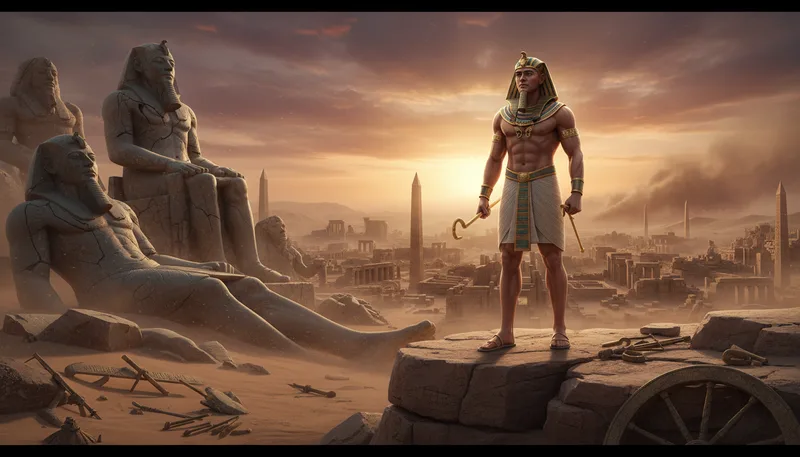
If the 18th Dynasty was characterized by elegance and religious revolution, the 19th Dynasty was characterized by bigness. This was the era of the "Mega-Pharaoh," dominated by a man who didn't just want to lead Egypt—he wanted to outshine history itself.
Ramses II, better known as Ramses the Great, took the throne around 1279 BCE. He would rule for an astonishing 66 years, father over 100 children, and leave his name carved so deeply into the stones of Egypt that it’s nearly impossible to visit the country today without encountering his face. But behind the propaganda lay a crumbling geopolitical landscape and a looming shadow that would eventually swallow the New Kingdom whole.
The Clash of Titans: The Battle of Kadesh
By the time Ramses took the throne, Egypt had a peer. In the north, the Hittite Empire (centered in modern-day Turkey) had expanded into Syria, threatening Egyptian trade routes. In Year 5 of his reign, Ramses marched north with 20,000 men to settle the score at the city of Kadesh.
The Battle of Kadesh was the largest chariot battle ever fought, involving roughly 5,000 vehicles. It was also a masterclass in ancient intelligence failure. Ramses, tricked by Hittite spies into thinking the enemy was miles away, rushed ahead of his main army with only his personal guard. The Hittites ambushed him, cutting through the Egyptian ranks like a bronze knife through papyrus.
Ramses claimed he fought off the entire Hittite army single-handedly, saved by the god Amun. In reality, he was saved by the timely arrival of elite reinforcements. The battle ended in a bloody stalemate. Ever the PR genius, Ramses returned to Egypt and covered every temple wall with reliefs claiming a total victory.
However, the real historical triumph came years later: the Egyptian-Hittite Peace Treaty. It is the oldest surviving written peace treaty in history, establishing a "brotherhood" between the two superpowers that lasted for decades.
Abu Simbel: The Stone Ego
With the borders stabilized, Ramses turned his attention to his favorite subject: himself. He embarked on a building program that put the Pyramid-builders to shame.
His masterpiece is Abu Simbel, carved directly into the mountainside of Nubia. Four colossal seated statues of Ramses, each 65 feet tall, stare out over the Nile. The temple is designed with such mathematical precision that twice a year, the sun’s rays penetrate 200 feet into the inner sanctuary to illuminate the statues of the gods—and, of course, Ramses himself.
But look closely at the temples of this era, and you’ll see a change. Ramses didn't just build new things; he "recycled." He had his name chiseled into the monuments of his predecessors, deeper than the original carvings so they couldn't be erased. It was a race against time and memory.
The Bronze Age Collapse
While Ramses was busy siring a small army of princes and princesses, the world outside the Nile Valley was beginning to burn. The late 13th century BCE saw the beginning of the Late Bronze Age Collapse —a mysterious, systemic failure of civilizations across the Mediterranean.
Trade routes were cut. Droughts led to mass migrations. Around the time of Ramses' successor, Merneptah, and the subsequent Ramses III, a shadowy confederation of invaders known as the Sea Peoples began to strike the Egyptian coast.
Ramses III won a series of desperate land and sea battles against these invaders, famously depicted in his mortuary temple at Medinet Habu. He saved Egypt from the immediate destruction that leveled the Hittites and the Mycenaean Greeks, but the cost was astronomical. The treasury was drained, and the Egyptian "spirit" was exhausted.
The Sunset of Empire
The end of the New Kingdom wasn't marked by a single battle, but by a slow, agonizing rot.
1. Economic Turmoil: Under Ramses III, Egypt saw the first recorded labor strike in history. The tomb-builders at Deir el-Medina walked off the job because their grain rations were months late.
2. The Harem Conspiracy: Ramses III was eventually murdered in a palace coup orchestrated by one of his minor wives—a grim contrast to the divine stability of earlier eras.
3. The Loss of the Levant: Unable to pay for its foreign garrisons, Egypt pulled back from its empire in Canaan and Syria. The "Golden Empire" was shrinking back into a provincial valley.
By the time Ramses XI died in 1070 BCE, the High Priests of Amun in Thebes had become so wealthy and powerful that they effectively ruled the south as a religious state, while a separate dynasty ruled the north from the city of Tanis.
The New Kingdom—the age of the chariots, the gold of the Pharaohs, and the world’s first empire—was over. Egypt would never again be the sole superpower of the ancient world. As the Third Intermediate Period began, the "Gift of the Nile" would find itself at the mercy of new, iron-willed empires rising in the East.
Comments
No comments yet. Be the first to share your thoughts.
Join the conversation
Log in to leave a comment on InEgypt.