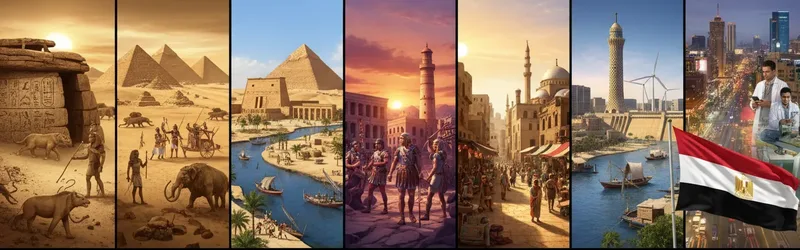

If the previous chapters were a story of Egyptian strength, Chapter 7 is a story of Egyptian resilience. By 525 BCE, the world had changed. The Bronze Age was a distant memory, and the new masters of the world fought with iron and relied on massive, multi-national bureaucracies.
Egypt was no longer the isolated superpower of the Nile; it had become the ultimate prize for every rising empire in the Mediterranean and the Near East. This era is defined by two massive waves of conquest that would forever alter the DNA of Egyptian culture: the arrival of the Persians and the whirlwind entry of Alexander the Great.
The Persian "Yoke"
In 525 BCE, the Persian Empire, led by Cambyses II, marched across the Sinai. At the Battle of Pelusium, the Egyptian army was crushed. Legend says the Persians painted images of cats—sacred to the Egyptians—on their shields, knowing the Egyptians would refuse to strike them. Whether true or not, the result was a bitter reality: for the first time, Egypt was merely a "Satraphy" (a province) of a foreign king sitting in far-off Susa.
The Persians were efficient but distant. They viewed Egypt as a "breadbasket" and a source of tax revenue. To the Egyptians, this was an existential crisis. They revolted constantly, briefly winning back their independence for sixty years (the 28th through 30th Dynasties), but it was the final gasp of native Egyptian rule. In 343 BCE, the Persians returned and reconquered the land, leaving the Egyptians praying for a liberator.
They got one in the form of a twenty-four-year-old Macedonian with a restless soul.
Alexander: The Pharaoh from the North
In 332 BCE, Alexander the Great swept into Egypt. He didn't come as a destroyer, but as a restorer. He understood something the Persians didn't: to rule Egypt, you had to *become* Egyptian.
Alexander took a grueling trek across the desert to the Siwa Oasis to consult the Oracle of Amun. The priests there addressed him as the "Son of Amun," effectively crowning him Pharaoh. By accepting the divine titles of the Old Kingdom, Alexander won the hearts of the people without firing a single arrow.
Before he left to finish his conquest of Persia, he paused at a small fishing village on the Mediterranean coast. He took a handful of grain and traced the outlines of a new city. He called it Alexandria. It would soon become the "Center of the World," the place where the wisdom of the Pharaohs met the philosophy of the Greeks.
The Rise of the Ptolemies
When Alexander died at thirty-two, his empire was carved up by his generals. Ptolemy, one of Alexander's most trusted commanders and perhaps his half-brother, grabbed Egypt. He knew it was the richest, most defensible piece of the map.
Ptolemy I Soter ("The Savior") founded the Ptolemaic Dynasty, a line of Greek-speaking kings and queens who would rule Egypt for nearly 300 years. They faced a unique challenge: they were Greeks ruling an ancient, deeply traditional Egyptian population. Their solution was a fascinating, often awkward, cultural fusion.
Alexandria: The Brain of the Ancient World
Under the first three Ptolemies, Alexandria became the greatest city on Earth. It was home to two wonders:
1. The Pharos (Lighthouse): A massive stone tower over 350 feet tall, its light visible for thirty miles, guiding the grain ships of the Mediterranean into the harbor.
2. The Great Library: A quest to collect every book in the known world. It was the world's first true university, where Eratosthenes calculated the circumference of the Earth and Euclid codified geometry.
A Tale of Two Cultures
While Alexandria was a gleaming Greek metropolis of marble and theaters, the rest of Egypt remained stubbornly Egyptian.
The Ptolemies built massive new temples—like Edfu and Philae—but they built them in the traditional Egyptian style, depicting themselves on the walls wearing the crowns of the Pharaohs and making offerings to Horus and Isis. They even created a "bridge" god named Serapis, who combined the Greek Zeus with the Egyptian Osiris.
Yet, the tension was always there. The Greeks held the high government offices; the Egyptians paid the taxes. The Ptolemies never even bothered to learn the Egyptian language—with one notable exception. At the end of the line sat a woman who would master the language, the politics, and the hearts of the two most powerful men in Rome.
The "Greek Shadow" was about to meet the "Roman Iron," and the final act of Ancient Egypt was about to begin.
Comments
No comments yet. Be the first to share your thoughts.
Join the conversation
Log in to leave a comment on InEgypt.