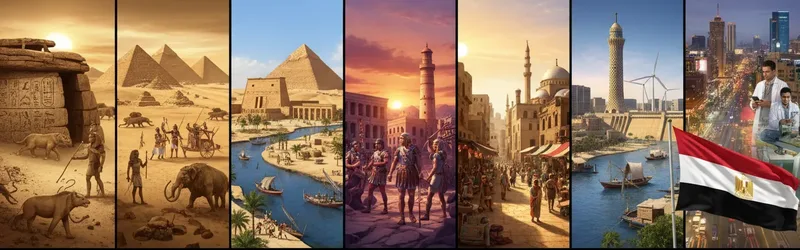

For three hundred years, Egypt became a "silent province." In 1517, the center of the Islamic world shifted from Cairo to Istanbul. The Ottoman Turks had transformed Egypt into their most lucrative satellite, a distant breadbasket and a source of tax revenue to fund their conquests in Europe.
But Egypt was never an easy land to tame. While an Ottoman Governor (the *Pasha*) sat in the Citadel, the old Mamluk beys never truly went away. They remained the "landlords of the Nile," creating a strange, fractured power-sharing agreement where the Ottomans held the title, but the Mamluks held the local influence. This era of stagnation and intrigue was eventually shattered by a thunderclap from the West: the arrival of the French.
The Land of the Sleeping Giants
Under Ottoman rule, Egypt was largely isolated from the Scientific Revolution and the Enlightenment sweeping through Europe. To the people living along the Nile, time seemed to stand still. Life was governed by the same cycles of the river that had existed since the time of the Pharaohs.
However, Cairo remained a city of incredible architectural beauty, though its grandeur was now that of a "faded queen." The Ottomans introduced their own style—slender, pencil-shaped minarets and vast, domed mosques—which began to mingle with the square, heavy towers of the Mamluk era.
The Mamluk Resurgence
By the 18th century, the Ottoman Empire was the "Sick Man of Europe," and its grip on Egypt loosened. The Mamluk Beys, particularly a man named **Ali Bey al-Kabir**, saw an opportunity. In 1768, he declared Egypt independent, struck his own coins, and even tried to reconquer Syria.
Though his rebellion was eventually crushed by Ottoman-backed rivals, it proved that the "Ottoman Shadow" was thinning. Egypt was a power vacuum waiting for a catalyst.
Napoleon’s Great Gamble: 1798
In May 1798, a young and ambitious Napoleon Bonaparte set sail from France with 35,000 soldiers and a fleet of 400 ships. His goal was not just to conquer Egypt, but to strike a blow against the British Empire by cutting off their overland route to India.
Napoleon brought more than just bayonets; he brought 167 scientists, artists, and scholars—the *savants*. He viewed himself as a modern Alexander the Great, intending to "liberate" the Egyptians from Mamluk tyranny and study the ancient wonders of the Pharaohs.
The Battle of the Pyramids
The clash of two worlds occurred in July 1798. On the plains of Giza, the Mamluk cavalry—still fighting with the medieval bravado of the Crusades—charged the French lines. Napoleon famously exhorted his men: "Soldiers! From the tops of these Pyramids, forty centuries look down upon you."
The result was a slaughter. The Mamluk swords were no match for the disciplined French squares and modern musketry. Napoleon took Cairo, but his victory was hollow. A few days later, the British Admiral **Horatio Nelson** found the French fleet at anchor in Aboukir Bay and blew it to pieces. Napoleon was trapped in his own conquest.
The Birth of Egyptology
While the military campaign was a disaster (Napoleon eventually abandoned his army and snuck back to France in 1799), the cultural impact was revolutionary.
The French savants fanned out across the country, sketching temples that had been buried in sand for millennia. Their work was compiled into the massive Description de l'Égypte, which ignited a global "Egyptomania." Most significantly, a French officer discovered a slab of black granodiorite near the town of Rashid: the Rosetta Stone. This artifact, containing the same decree in Hieroglyphs, Demotic, and Greek, would finally allow Jean-François Champollion to crack the code of ancient Egyptian writing.
The Vacuum and the Turk
The French were forced out by the British and Ottomans in 1801, leaving Egypt in a state of total anarchy. The Mamluks were broken, the Ottomans were weak, and the British weren't ready to stay.
Out of this chaos stepped a young commander of an Albanian mercenary unit serving the Ottomans. His name was Muhammad Ali, and he was about to do more than just rule Egypt—he was going to drag it, kicking and screaming into the modern age.
Comments
No comments yet. Be the first to share your thoughts.
Join the conversation
Log in to leave a comment on InEgypt.