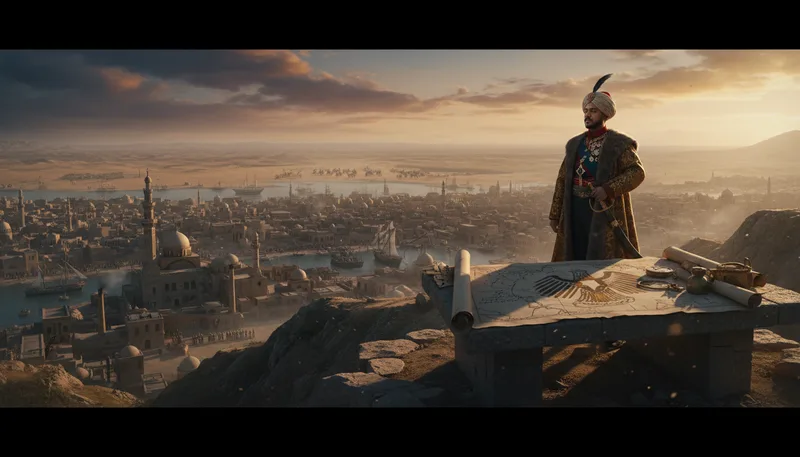
If Napoleon was the one who woke Egypt from its three-hundred-year sleep, Muhammad Ali Pasha was the one who handed it a rifle, a factory manual, and a map of the world.
An Albanian tobacco trader turned mercenary commander, Muhammad Ali arrived in Egypt with the Ottoman army to kick out the French. By 1805, he had skillfully played the various factions—the Ottomans, the Mamluks, and the local religious leaders—against each other until the people of Cairo demanded *he* be named Governor. But he had no intention of being a mere servant of Istanbul. He intended to build a dynasty.
The Massacre at the Citadel: 1811
Before Muhammad Ali could modernize Egypt, he had to remove the "ghosts" of its past. The Mamluk Beys still controlled much of the land and wealth. In 1811, he invited 470 of the leading Mamluks to a celebration at the Citadel.
As the Mamluks marched down the narrow, high-walled passage toward the gate, the doors were slammed shut. Muhammad Ali’s Albanian sharpshooters, perched on the walls above, opened fire. It was a cold, calculated bloodbath. In one afternoon, the military caste that had ruled Egypt since the Middle Ages was erased. The "Old Egypt" was dead; Muhammad Ali was now the sole master of the Nile.
The Industrial Revolution on the Nile
Muhammad Ali realized that for Egypt to be independent, it had to be strong. To be strong, it had to be industrial. He launched a "Top-Down" revolution:
Monopoly System: He took control of all agricultural land, forcing farmers to grow specific crops—most notably Long-Staple Cotton. This "White Gold" became Egypt's primary export, fueling the textile mills of Europe and filling Egypt’s treasury.
* Factories and Schools: He built the first modern textile mills, sugar refineries, and arms factories in the Middle East. He sent "educational missions" of Egyptian students to Paris and London to learn engineering, medicine, and printing.
* The New Army (Nizam-i Cedid): He replaced the disorganized mercenary units with a professional army based on the French model. For the first time since the Pharaohs, the Egyptian *fellahin* (peasants) were conscripted into a national army.
The Builder of the Delta
To feed his growing industry, Muhammad Ali overhauled the very geography of Egypt. He built the Delta Barrage, a massive dam project that allowed for perennial irrigation. This meant the land could be farmed year-round, not just after the annual flood. This move fundamentally changed the lives of millions, though it also increased the burden of labor on the peasantry.
The Empire That Almost Was
By the 1830s, Muhammad Ali’s army was so powerful that it began to outshine his Ottoman masters. His son, Ibrahim Pasha, led Egyptian forces across the Levant and deep into Anatolia, coming within striking distance of Istanbul itself.
The European powers—Britain, Russia, and Austria—panicked. They didn't want a strong, modernized Egyptian Empire replacing the "Sick Man of Europe" (the Ottomans). In 1840, the British Navy intervened, forcing Muhammad Ali to retreat. He was allowed to keep Egypt as a hereditary kingdom for his family, but his dream of a vast Middle Eastern empire was crushed.
The Suez Dream and the Debt Trap
Muhammad Ali died in 1849, but his successors (the Khedives) continued his grand vision with varying degrees of success. His grandson, Khedive Ismail, famously declared, "My country is no longer in Africa; we are now part of Europe."
Ismail’s crowning achievement was the Suez Canal, opened in 1869 with a celebration so lavish it included the commissioning of Verdi’s opera Aida. The canal was a wonder of the world, cutting the journey from Europe to Asia by thousands of miles.
But there was a catch. The modernization, the wars, and the canal had been built on borrowed money. By the 1870s, Egypt was bankrupt. To pay the debts, Ismail was forced to sell Egypt’s shares in the Canal to the British.
The "Founder of Modern Egypt" had created a powerhouse, but his heirs had mortgaged it to the West. The shadow of the Ottoman was gone, replaced by a much longer, colder shadow: the British Empire.
Comments
No comments yet. Be the first to share your thoughts.
Join the conversation
Log in to leave a comment on InEgypt.