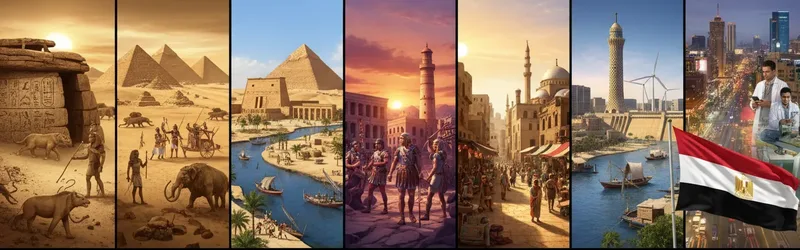
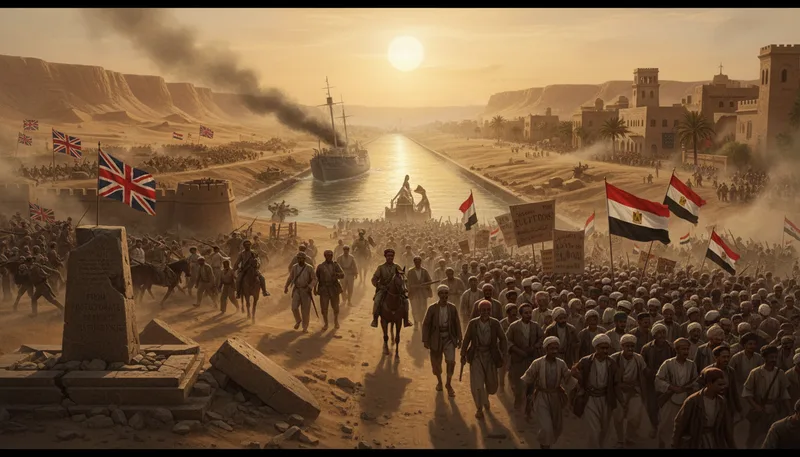
The opening of the Suez Canal in 1869 was supposed to be Egypt’s crowning moment. Instead, it became the noose that pulled the country into the orbit of the British Empire. For seventy years, Egypt would exist in a strange, frustrating limbo: a nation with its own King and its own flag, but where the real power resided in the office of the British Consul-General in Cairo.
This chapter is the story of a long, simmering resistance. It is the journey from "veiled protectorate" to a modern, independent Republic—a transformation fueled by two World Wars, a charismatic colonel, and the end of 300 years of royal rule.
The "Veiled Protectorate": 1882–1914
By 1882, internal unrest against foreign influence and the Khedive’s debts led to the Urabi Revolt, a nationalist uprising with the slogan "Egypt for the Egyptians." Fearing for their investment in the Suez Canal, the British bombarded Alexandria and landed troops.
The British stayed for decades. They claimed they were there only to "restore order" and manage the finances, but they effectively ran the country. Under **Lord Cromer**, Egypt became a plantation for the British textile industry. The Nile was managed with clinical efficiency, but political freedoms were stifled. The Egyptians were told they were "not yet ready" for self-rule—a sentiment that only hardened their resolve.
The 1919 Revolution
When World War I broke out, Britain officially declared Egypt a Protectorate, cutting the final symbolic ties to the Ottoman Empire. Egyptians were conscripted into labor corps and their livestock seized for the war effort.
In 1919, after the British refused to allow an Egyptian delegation (*Wafd*) to attend the Paris Peace Conference to argue for independence, the country exploded. This wasn't just a military coup; it was a true national uprising. Men and women, Muslims and Christians, peasants and students took to the streets. The British were forced to grant "unilateral independence" in 1922, but with so many strings attached—including a permanent British military presence—that many Egyptians felt it was a sham.
The Era of the King and the Canal
The 1920s and 30s were a period of "liberal experiment." Egypt had a parliament and a colorful, if increasingly decadent, monarchy under King Fuad and later his son, King Farouk.
Cairo became the "Paris of the Nile," a city of grand boulevards, jazz clubs, and a burgeoning film industry that made Egypt the cultural heart of the Arab world. But beneath the glamour, the pressure was building. The gap between the ultra-rich elite and the starving *fellahin* was a chasm. To make matters worse, World War II brought hundreds of thousands of Allied troops back to Egyptian soil, reminding everyone who was really in charge.
The 1952 Revolution: The Free Officers
By 1952, the Egyptian monarchy was seen as a corrupt puppet of the British. The humiliating defeat in the 1948 Arab-Israeli War was the final straw for the military.
In the early hours of July 23, a group of young, middle-class military men known as the **Free Officers** seized control of the government in a nearly bloodless coup. King Farouk was forced to abdicate and sail away on his royal yacht, *Mahroussa*. The 3,000-year-old tradition of monarchy in Egypt—from Narmer to the Ptolemies to Muhammad Ali—was over.
Gamal Abdel Nasser: The Voice of the Arabs
While General Muhammad Naguib was the first President, the true architect of the new Egypt was Gamal Abdel Nasser. Nasser was a charismatic, populist leader who embodied a new sense of dignity. He wasn't a descendant of Turks or Albanians; he was the son of a postman from Upper Egypt. He was the first native Egyptian to truly rule the country in over two millennia.
In 1956, Nasser made a move that shocked the world: he nationalized the Suez Canal. He argued that the canal belonged to the people whose ancestors had died digging it.
The Suez Crisis and the Birth of a New Identity
Britain, France, and Israel responded with a coordinated invasion. Militarily, they succeeded, but politically, they failed. Under pressure from both the U.S. and the Soviet Union, the invaders were forced to withdraw.
Nasser emerged as a global hero—the man who stood up to the old colonial powers and won. He launched a program of Arab Socialism, redistributing land to the peasants and building the Aswan High Dam, a massive project that finally tamed the Nile's floods once and for all.
Egypt was no longer a "gift" or a "province." It was the leader of the Pan-Arab movement and a titan of the Non-Aligned Movement. But the cost of this new identity was high. The focus on the military and the state led to a series of wars with Israel, culminating in the devastating **Six-Day War of 1967**. When Nasser died in 1970, he left behind a nation that was fiercely independent but exhausted, standing on the threshold of a new, uncertain modern era.
Comments
No comments yet. Be the first to share your thoughts.
Join the conversation
Log in to leave a comment on InEgypt.