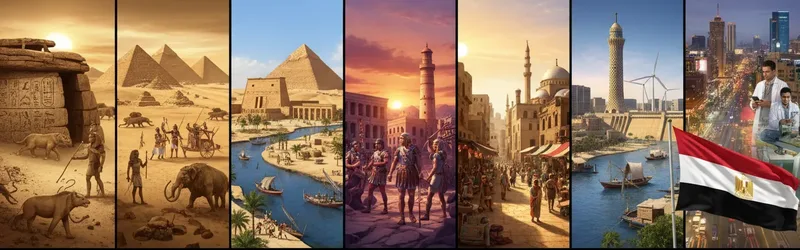

The story of Egypt does not begin with a crown, a pyramid, or a golden mask. It begins with a shift in the wind and the slow, agonizing death of a grassland.
Ten thousand years ago, the region we now call the Sahara was not a void of shifting dunes and sun-bleached bones. It was a "Green Sahara"—a sprawling savanna of tall grasses, seasonal lakes, and acacia trees. Giraffes, elephants, and lions roamed across what is now the Libyan Desert. Human hunter-gatherers lived here in a nomadic paradise, chasing game and gathering wild grains. But around 6000 BCE, the Earth’s tilt shifted ever so slightly. The monsoons that fed the savanna retreated south. The lakes evaporated, the grass turned to straw, and the sand began its relentless march.
For the people of the Sahara, the world was ending. They were forced to flee the encroaching heat, moving toward the only reliable source of life in a dying landscape: a deep, green trench cut into the limestone floor of the northeast corner of Africa.
They moved toward the Nile.
The Great Compressor
Herodotus, the Greek historian, famously called Egypt "the gift of the Nile." It’s a poetic phrase, but it undersells the sheer violence of the geography. The Nile didn’t just give life; it forced it into a specific, pressurized shape.
The Nile Valley is a narrow ribbon of fertility, rarely more than twelve miles wide, hemmed in on both sides by the *Deshret*—the "Red Land" of the inhospitable desert. To the south lay the rocky cataracts of Nubia; to the north, the marshy fan of the Delta. This geography acted as a "social compressor." Unlike the vast plains of Mesopotamia where tribes could wander and escape one another, the early Egyptians were trapped together in a long, thin tube.
This forced proximity was the catalyst for civilization. You couldn't just move away from a difficult neighbor; you had to cooperate with them to manage the water, or you had to conquer them.
The Rhythm of the Inundation
The settlers soon discovered that the Nile was a god with a very strict schedule. Every summer, fueled by the monsoon rains in the Ethiopian highlands, the river would swell and burst its banks. This was the *Akhet*, the season of the Inundation.
When the water receded, it left behind a layer of thick, black, nutrient-rich silt. This was the *Kemet*—the "Black Land." This mud was so fertile that it practically did the work for the farmers. While the rest of the ancient world broke their backs tilling stubborn soil, the Egyptians threw seeds into the mud and let their pigs trample them in.
Because the food supply was predictable, the population exploded. By 4000 BCE, the scattered hamlets of the valley began to coalesce into larger settlements. These weren't just villages; they were the "Nomes," or administrative districts, each with its own local chieftain, its own animal totem (the Falcon, the Jackal, the Scorpion), and its own fierce pride.
The Two Lands: Red Crowns and White Crowns
As the centuries passed, these Nomes began to merge through trade, marriage, and bloody skirmishes. By 3300 BCE, the political map had simplified into two distinct power blocks:
1. Upper Egypt (The South): Despite being "at the bottom" of a map, it is "Up-stream." This was a rugged, valley-dwelling culture represented by the White Crown (*Hedjet*) and the protective spirit of the vulture goddess, Nekhbet.
2. Lower Egypt (The North): The lush, swampy Delta. This was a more cosmopolitan, trade-oriented culture represented by the Red Crown (*Deshret*) and the cobra goddess, Wadjet.
The tension between these two regions defines the Egyptian psyche. They were the "Two Lands," culturally similar but politically divided. To the Egyptians, duality was the natural state of the universe: Black Land vs. Red Land, Life vs. Death, North vs. South.
The story of the unification is where history meets myth, personified by a figure who might have been one man, or perhaps several: Narmer.
The Unifier: The Legend of Narmer
If you look at the Narmer Palette—a shield-shaped siltstone slab carved over 5,000 years ago—you are looking at the birth certificate of a nation.
On one side, a king named Narmer wears the White Crown of the South. He is depicted in a "smiting pose," holding a mace over the head of a kneeling captive from the North. On the reverse side, he is shown parading in the Red Crown of the conquered North, preceded by standard-bearers and walking past the decapitated corpses of his enemies.
Around 3100 BCE, Narmer (often associated with the legendary King Menes) did the impossible. He bridged the duality. By force of arms and political genius, he fused the Red and White crowns into the *Pschent*—the Double Crown.
He moved the capital to the "Balance of the Two Lands," a city called Memphis, located exactly where the narrow valley opens up into the wide Delta. From this strategic point, he could control the flow of both grain and people.
The Birth of the First Dynasty
With unification came the birth of the state. It wasn't enough to just rule; the early kings had to justify *why* they ruled. They didn't claim to be chosen by the gods; they claimed to *be* the gods.
The king became the living Horus, the falcon-headed sky god. This was the masterstroke of Egyptian stability: if the king is a god, then rebellion isn't just a political crime—it’s a violation of the cosmic order, or Ma’at.
Ma’at is the most important concept in Egyptian history. It represents truth, balance, and order. The Nile flooded on time because of Ma’at. The sun rose because of Ma’at. And the King was the sole guarantor of Ma’at. Without a single ruler at the helm, the Egyptians believed the world would literally dissolve back into the chaotic waters of the prehistoric void.
The Foundation is Set
By the end of the First Dynasty, the blueprint for the next 3,000 years was already etched in stone.
The Bureaucracy: They had developed hieroglyphic writing, not for poetry, but for taxes and grain accounting.
The Religion: The cult of the sun and the obsession with the afterlife were already taking root.
The King: The Pharaoh (though not yet called by that title) was established as the absolute pivot point of human existence.
The Sahara had turned to dust, but the refugees who huddled by the river had built something far more durable. They had turned a narrow strip of mud into the world's first great nation-state. The "Gift of the Nile" had been unwrapped, and the stage was set for the Age of Gold.
Comments
No comments yet. Be the first to share your thoughts.
Join the conversation
Log in to leave a comment on InEgypt.