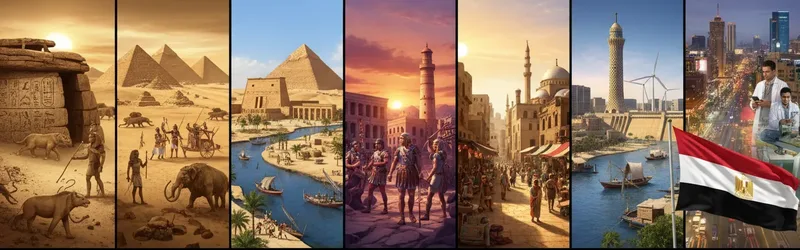
By the 10th century, the unified Islamic Caliphate had begun to fracture. While the Abbasid Caliphs in Baghdad were busy with Persian poets and Turkish mercenaries, a new power was rising in the West. This was the era of the Fatimids and the Ayyubids —a period where Egypt transformed from a tax-paying province into the seat of a global empire, and later, the primary shield of aIslam against the Crusades.
This chapter follows Egypt’s rise to the center of the world stage, the founding of its most famous city, and the emergence of a leader whose name still resonates through history: Saladin.
The Rise of the Fatimids: The Great City of Mars
In 969 CE, a group of Shia Muslims known as the Fatimids (claiming descent from the Prophet’s daughter, Fatima) marched out of Tunisia and conquered Egypt. They didn't want to live in the old city of Fustat. Instead, they moved a few miles north to a site that their astrologers deemed auspicious because the planet Mars (*al-Qahir*) was rising.
They called their new city al-Qahira—"The Victorious." To the Western world, it became Cairo.
The Fatimids were a paradox. Though they were "heretics" in the eyes of the Sunni world, they presided over a golden age of tolerance and intellectual brilliance. They founded Al-Azhar, which remains one of the oldest universities in the world. Cairo became a rival to Baghdad and Constantinople, a city of ivory, silk, and a legendary palace library that supposedly held 600,000 volumes.
The Shadow of the Cross: The Crusader Threat
The Fatimid Golden Age eventually gave way to a "Century of Woe." A series of low Nile floods led to famine, and the Caliphs became puppets of their own viziers. Sensing this weakness, the Crusaders — who had established the Kingdom of Jerusalem in 1099—turned their hungry eyes toward Egypt.
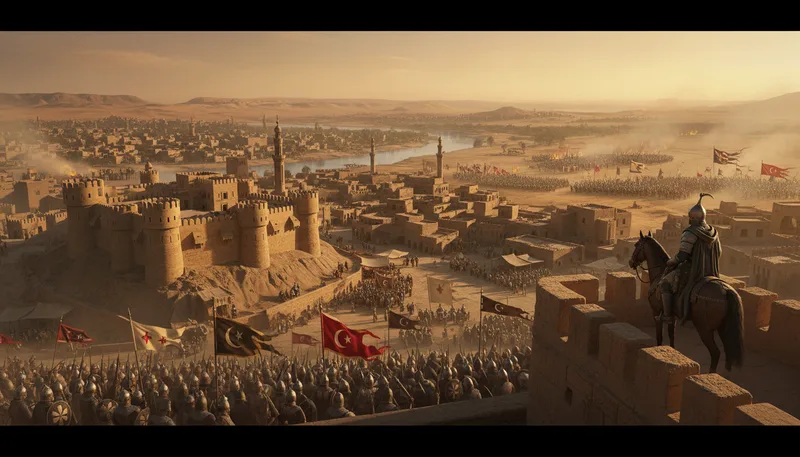
The Crusaders knew that whoever held the Nile held the key to the entire Middle East. For years, Egypt became a bloody chessboard where the Crusaders and the Zengid Turks of Syria fought for control. Amidst this chaos, a young Kurdish officer named Salah ad-Din (Saladin) arrived in Cairo as part of a Syrian expeditionary force.
Saladin and the Shield of Egypt
Saladin was a man of quiet charisma and terrifying competence. By 1169, he had maneuvered himself into the position of Vizier of Egypt. Two years later, he quietly abolished the Fatimid Caliphate, restored Egypt to Sunni orthodoxy, and founded the Ayyubid Dynasty.
Saladin realized that if he were to defeat the Crusaders, he first had to unite the Muslim world. He used Egypt as his "engine." Its wealth paid for his armies, and its grain fed his campaigns. To protect his new capital, he built the Citadel of Cairo, a massive limestone fortress that would remain the seat of Egyptian government for the next 700 years.
The Lion and the King
In 1187, Saladin destroyed the Crusader army at the Battle of Hattin and recaptured Jerusalem. This triggered the Third Crusade, bringing him face-to-face with Richard the Lionheart.
The rivalry between Saladin and Richard became the stuff of legend. While they were enemies on the battlefield, they exchanged gifts and medical advice. When Richard’s horse was killed, Saladin sent him two fresh mounts; when Richard fell ill with fever, Saladin sent him fruit and snow from the mountains. This was the "Age of Chivalry," where war was a brutal but highly codified game of honor.
The Birth of the Mamluks
Saladin’s successors, the Ayyubids, faced a constant manpower problem. They were a small elite ruling a massive population. To solve this, they began to import "Slave-Soldiers" from the steppes of Central Asia and the Caucasus. These were the Mamluks.
Trained from childhood in the arts of the bow and the horse, the Mamluks were the finest cavalry in the world. They were "owned" by the Sultan, but they were not slaves in the Western sense; they were a military aristocracy.
By the mid-13th century, as the Ayyubid Sultans grew weak and the Mongols began their terrifying march toward the Mediterranean, the Mamluks decided they had had enough of serving masters. In a violent palace coup, they murdered the last Ayyubid heir and took the throne for themselves.
Egypt was no longer a kingdom of hereditary kings. It was now a Mamluk Sultanate—a "Republic of Slaves" that would soon face the greatest threat the world had ever seen.
Comments
No comments yet. Be the first to share your thoughts.
Join the conversation
Log in to leave a comment on InEgypt.