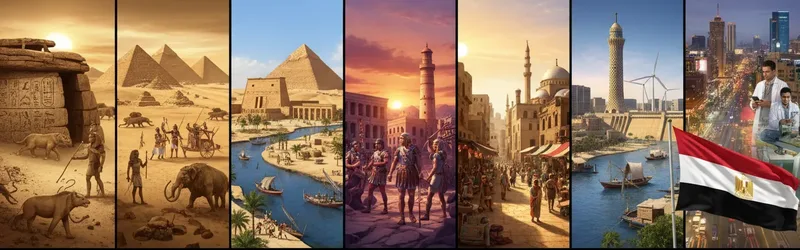
The suicide of Cleopatra VII in 30 BCE was more than the death of a queen; it was the death of an era. For three thousand years, Egypt had been a sovereign entity—sometimes an empire, sometimes divided, but always possessing a distinct heart that beat for itself. When Octavian (the future Emperor Augustus) entered Alexandria, that heart was essentially placed on life support. Egypt was annexed, but not as a standard province. Augustus, wary of the wealth and strategic power of the Nile, declared it the personal property of the Emperor. No Roman Senator could even visit the land without his express permission.Egypt had become the "Crown Jewel" of the Roman Empire, but it was a jewel destined to be mined until it was hollow. For the next six centuries, the story of Egypt was a story of hyper-efficiency, religious transformation, and a slow-burning tension between the ancient identity of the Nile and the iron-fisted requirements of Rome and Byzantium.
The Imperial Breadbasket: The Economics of the Annona
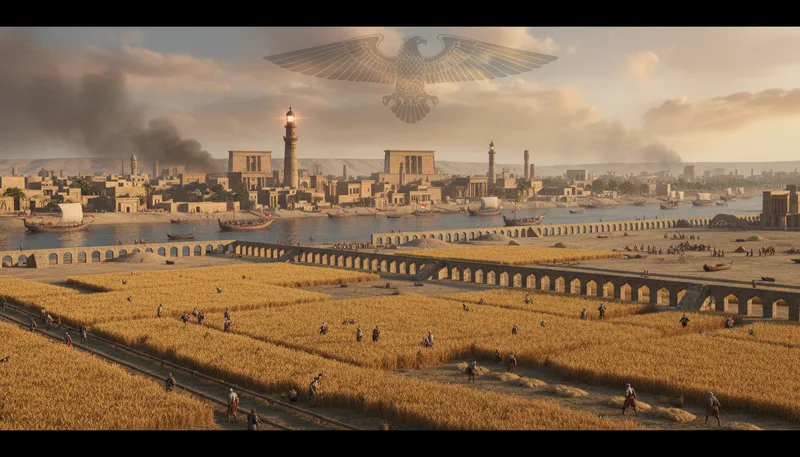
Rome was a city of nearly a million people, and it was a city that did not feed itself. The stability of the Emperor’s throne depended on the Annona—the state-organized grain dole. If the bread ran out, the mobs in the Colosseum would turn into a revolutionary force. To prevent this, Rome turned to Egypt with a predatory focus.The Romans viewed the Nile Valley as a massive, organic factory. They applied a level of administrative rigor that even the Ptolemies would have found staggering. Every plot of land was surveyed, every irrigation canal was mapped, and every bushel of wheat was tracked from the field to the harbor.The Logistics of the Grain Fleet
Every year, the "Inundation" of the Nile determined the fate of the Roman world. If the river rose too high, it destroyed villages; if it stayed too low, famine followed. Once the grain was harvested, it was loaded onto the Classis Alexandrina—the great grain fleet. These were the supertankers of antiquity. Some of these vessels were monsters of the sea, capable of carrying 1,200 tons of grain.The voyage from Alexandria to the Roman port of Ostia was a lifeline. When the first ships of the season appeared on the horizon, the people of Rome celebrated as if a war had been won. But for the Egyptian fellahin (peasants), this was a cycle of exhaustion. They were taxed by the head, by the land, and by the crop. While Rome ate for free, the people who grew the food often lived on the edge of subsistence.Alexandria: The Splendor and the Powder Keg
If the countryside was a factory, Alexandria remained the glittering showroom. Under Roman rule, it remained the second city of the Empire, surpassed only by Rome itself. It was the center of Mediterranean trade, the gateway to the exotic luxuries of India and Arabia, and the undisputed capital of the intellect.The Museum and the Library
The Great Library may have suffered during Caesar’s wars, but Alexandria remained the "Brain of the World." It was here that Ptolemy (the scientist, not the king) mapped the stars and codified the geocentric model of the universe that would endure for 1,400 years. It was here that Galen refined the study of anatomy. The city was a forest of marble columns, wide boulevards, and the towering Pharos lighthouse that still blinked its warning to ships across the sea.A City of Riots
However, beneath the marble was a simmering cauldron of ethnic hatred. Alexandria was divided into quarters: the Greek quarter, the Jewish quarter, and the "Egyptian" quarter (Rhakotis).- The Greeks felt they were the rightful heirs to the city and resented Roman oversight.
- The Jews were a massive, prosperous community that sought equal rights, leading to frequent, bloody pogroms and urban warfare.
- The Romans played the groups against each other, acting as the weary referees of a city that seemed to love a good riot more than it loved its own peace.
The Rise of the Cross: From Secret Cult to State Religion
In the mid-1st century CE, a new influence arrived in Alexandria, allegedly brought by St. Mark the Evangelist. It was a religion that spoke to the disenfranchised, the taxed-to-the-bone, and those who found the old gods of the Pharaohs and the Greeks to be distant and cold.Christianity found fertile soil in Egypt. The ancient Egyptian obsession with the afterlife and the concept of a resurrected god (Osiris) made the story of Jesus Christ feel strangely familiar, yet revolutionary.The Coptic Identity
As the religion spread south along the Nile, it merged with the local culture to create the Coptic identity. The word "Copt" is simply a corruption of the Greek Aigyptos (Egyptian). The Copts developed their own script—using Greek letters to write the ancient Egyptian language. This was a crucial moment in history; it allowed the native language of the Pharaohs to survive the death of the temples, even if the ability to read hieroglyphs was beginning to fade.The Desert Fathers: The Invention of Monasticism
Egypt gave the world a unique form of Christian expression: Monasticism. In the 3rd and 4th centuries, men like St. Anthony the Great decided that the only way to truly follow Christ was to flee the corruption and heavy taxes of the Roman cities.They fled into the "Red Land"—the harsh, unforgiving desert. These "Desert Fathers" lived in caves, fasted for weeks, and sought a direct, mystical connection with God. This movement exploded in popularity. Soon, the desert was "populated" by thousands of monks and nuns. They built the world’s first monasteries, like St. Catherine’s in the Sinai or the monasteries of Wadi El Natrun. These became fortresses of literacy and faith that would preserve Egyptian culture through the coming storms.The Era of the Martyrs
The Roman state did not take kindly to this new, stubborn faith. Because Christians refused to perform sacrifices to the Emperor’s genius, they were seen as traitors.The peak of this tension came under Emperor Diocletian in 303 CE. The "Great Persecution" hit Egypt harder than almost anywhere else. Thousands were executed in the arenas of Alexandria or sent to work to death in the quarries of the Eastern Desert. The Coptic Church was so traumatized by this era that they reset their entire calendar to begin in 284 CE (the year of Diocletian’s accession), calling it the Era of the Martyrs. To this day, the Coptic calendar remains a living monument to Roman cruelty.The Byzantine Shift and the Theological Schism
In 313 CE, everything changed. Constantine the Great legalized Christianity, and by the end of the century, it was the state religion. The capital of the Empire moved to Constantinople, and Egypt became a Byzantine province.You might think this would bring peace to Egypt, but it brought the opposite: Theological Warfare. The Byzantine Emperors wanted a unified Church, but the Egyptians were fiercely independent.The conflict centered on the nature of Christ. Was he fully divine, fully human, or a perfect blend of both? At the Council of Chalcedon in 451 CE, the Egyptian (Coptic) view was rejected as "heresy." The Church split. From that moment on, the Egyptians viewed the Byzantine officials in Constantinople not as fellow Christians, but as "Melkites" (the King’s Men)—foreign oppressors who tried to dictate how they should pray.This schism was the beginning of the end for Roman/Byzantine rule. The Egyptians were alienated from their rulers. The Emperor in Constantinople was seen as a tax-collector and a religious bully.The Last Hieroglyph and the Silence of the Gods
While the bishops argued, the old world was dying. The Roman state ordered the closure of all pagan temples. The Great Library’s remnants were scattered, and the temples of Isis and Serapis were turned into churches or stables.In 394 CE, on the island of Philae at the southern border of Egypt, a lonely priest carved a small inscription into a temple wall. It was a prayer to the god Mandulis. It is the last known hieroglyphic inscription in history.After that, the "Sacred Carvings" fell silent. For the next 1,440 years, no human being on Earth would be able to read the names of Ramses, Hatshepsut, or Khufu. The ancient Egyptian religion, which had lasted longer than Christianity has existed to this day, vanished into the sand. Egypt was now a land of icons, incense, and bells.The Byzantine Exhaustion and the Persian Shock
By the early 7th century, the Byzantine Empire was a shadow of its former self. It had spent decades in a "World War" with the Sassanid Persian Empire. In 619 CE, the Persians actually succeeded in conquering Egypt, holding it for a decade.When the Byzantine Emperor Heraclius finally won Egypt back in 629 CE, he celebrated a great triumph, but he returned to a province that was bitter and broken. He immediately tried to force religious unity on the Copts again, leading to more arrests and executions.The Egyptians were exhausted. Their wealth had been drained to pay for Byzantine wars, their faith had been mocked by Byzantine bishops, and their land had been trampled by Persian boots. They were a people looking for an exit strategy.They didn't have to wait long. In the year 639 CE, a cloud of dust appeared on the eastern horizon of the Sinai. It was not a Roman legion or a Persian horde. It was a group of four thousand horsemen from the Arabian Peninsula, carrying a new message and a new law. The Roman era—the era of the grain ships and the marble theaters—was about to collapse like a house of cards.Legacy of the Roman Years
The six centuries of Roman and Byzantine rule left a permanent mark on Egypt. They left behind the fortress of Babylon in Cairo, the ruins of Antinopolis, and the thousands of papyrus scrolls buried in the trash heaps of Oxyrhynchus that give us our best look at daily life in the ancient world.But more importantly, they left behind the Coptic Church, a living link to the language and spirit of the Pharaohs. Rome had treated Egypt as a stomach to be filled, but in doing so, it had inadvertently created the conditions for a new, resilient Egyptian identity that would survive the coming of Islam and endure into the modern day.The "Gift of the Nile" was about to be passed to a new master, but it was a gift that came with a warning: Egypt is easy to conquer, but impossible to truly own.
Comments
No comments yet. Be the first to share your thoughts.
Join the conversation
Log in to leave a comment on InEgypt.