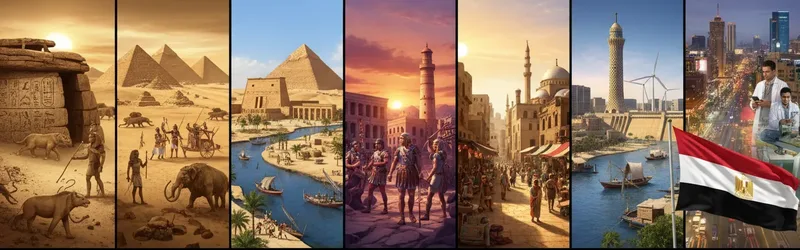

If the era of Nasser was defined by revolutionary fire and Pan-Arab dreams, the decades that followed were a cold, hard look at reality. Egypt entered the late 20th century as a nation trying to balance its ancient heritage, its strategic importance in the Cold War, and the rising demands of a population that was growing faster than the Nile could feed it.
From the dramatic peace of the 1970s to the digital-age protests of the 21st century, this chapter explores an Egypt that is no longer an empire or a colony, but a modern state navigating the complexities of a globalized world.
Sadat and the Great Pivot
When Anwar Sadat took over in 1970, he inherited a country in mourning. The 1967 defeat had left the Sinai Peninsula under Israeli occupation and the national spirit broken. Sadat, a master of theater and strategy, decided to flip the script.
In 1973, he launched the Yom Kippur War (the October War). While the military outcome was complex, the initial Egyptian crossing of the Suez Canal shattered the myth of Israeli invincibility. Having restored Egyptian honor, Sadat did the unthinkable: he flew to Jerusalem to address the Israeli Knesset.
The resulting 1979 Camp David Accords saw Egypt become the first Arab nation to recognize Israel. For this, Sadat won the Nobel Peace Prize, but he also lost his life—assassinated by extremists during a military parade in 1981. He left Egypt with its land restored but its relationship with the rest of the Arab world in tatters.
The Era of Stability and Stagnation: Hosni Mubarak
For nearly thirty years, Hosni Mubarak ruled Egypt with a "steady hand" that many eventually saw as a heavy one. This was the era of the *Infitah* (opening), where Egypt shifted toward a market economy. Cairo expanded into a sprawling megacity of twenty million people, its suburbs reaching out to touch the very feet of the Giza Pyramids.
Mubarak became a key Western ally, a "pillar of stability" in a volatile region. But beneath the surface, the pressure was reaching a breaking point. High unemployment, police brutality, and a growing divide between the billionaire elite and the urban poor created a tinderbox.
Tahrir Square: The 2011 Revolution
On January 25, 2011, the tinderbox ignited. Inspired by the "Arab Spring" in Tunisia, hundreds of thousands of Egyptians flooded into Tahrir Square in the heart of Cairo.
This wasn't a military coup; it was a digital-age uprising. Young Egyptians used social media to organize, demanding "Bread, Freedom, and Social Justice." After eighteen days of televised protests that transfixed the world, Mubarak resigned. The "Wall of Fear" had been broken.
The New Republic
The years following 2011 were a whirlwind of transition. Egypt held its first democratic elections, leading to the brief and polarizing presidency of Mohamed Morsi, before a second wave of mass protests in 2013 led to his removal by the military.
Since 2014, under Abdel Fattah el-Sisi, Egypt has embarked on a massive program of national reconstruction. The focus has shifted back to the grand engineering projects reminiscent of the Pharaohs or Muhammad Ali:
* The New Administrative Capital: A massive, high-tech city being built in the desert outside Cairo to relieve the congestion of the ancient capital.
* The New Suez Canal: A multi-billion dollar expansion to double the waterway's capacity.
* The Grand Egyptian Museum: A billion-dollar "New Home for Tutankhamun" overlooking the Giza plateau, intended to be the largest archaeological museum in the world.
The Eternal River
As we look at Egypt today, the challenges are as old as the Nile itself. The country must manage a population that has crossed the 110 million mark, navigate regional tensions over water rights with upstream neighbors, and maintain its cultural identity in an age of TikTok and global trade.
Yet, as it has done for 5,000 years, Egypt persists. It is a land where a farmer might check his smartphone while plowing a field with a tool that hasn't changed since the Middle Kingdom. It is a nation that has survived the rise and fall of Persians, Greeks, Romans, Arabs, and Brits, absorbing each culture and making it uniquely "Egyptian."
The "Gift of the Nile" remains—a resilient, vibrant, and eternally shifting civilization that continues to serve as the heartbeat of the Middle East.
Epilogue: The Horizon of the Sun
The story of Egypt is not a straight line; it is a cycle, much like the rising and setting of the sun (*Ra*) that the ancients worshipped. From the first stones of Saqqara to the glass towers of the New Capital, the Egyptian people have proven that while empires are temporary, the river—and the spirit of those who live beside it—is eternal.
Comments
No comments yet. Be the first to share your thoughts.
Join the conversation
Log in to leave a comment on InEgypt.